
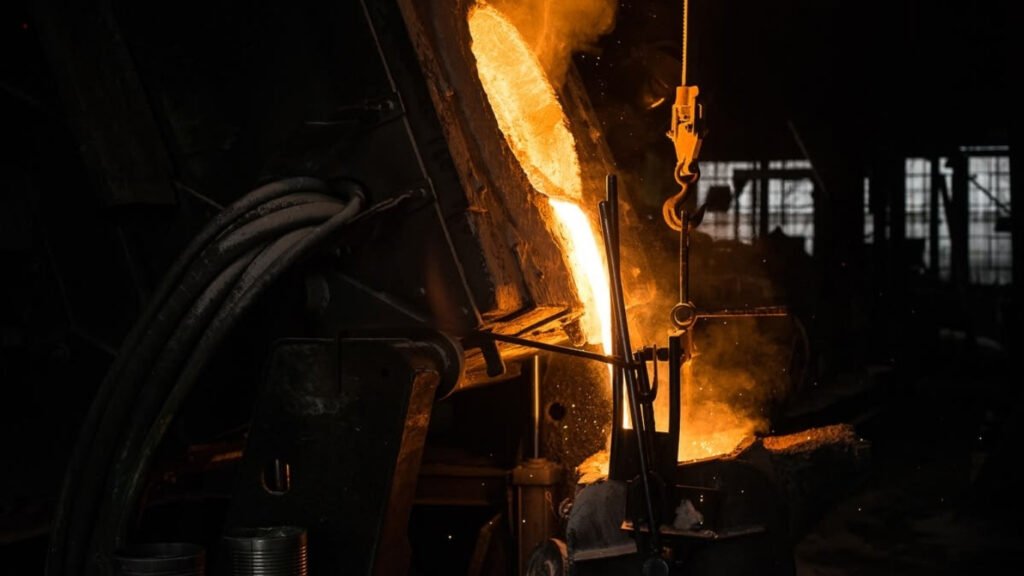
Cast Iron's Role in Modern Industrial Supply Chains; Why European Manufacturers Still Choose It?
Every year, European manufacturers evaluate their material choices. Aluminium alloys are lighter. Advanced steels are stronger in tension. Engineered polymers are cheaper for low load applications. And yet, across construction equipment, agricultural machinery, lifting systems, elevator counterweights, and industrial machinery bases cast iron remains the specified material.
This is not inertia. It is a rational procurement decision made by engineers who have run the numbers, tested the alternatives, and come back to the same conclusion: for a specific and commercially significant set of industrial applications, cast iron is still the most cost effective, technically reliable, and lifecycle efficient material available.
This article examines why that is what properties make cast iron uniquely suited to industrial supply chains, where European manufacturers concentrate their demand, and what buyers and procurement managers need to understand when sourcing it.
Key Takeaway
Cast iron is not a legacy material kept in industrial supply chains out of habit. It occupies specific, well-defined roles where its combination of density, vibration damping, compressive strength, machinability, and lifecycle cost is unmatched by any single alternative. European manufacturers know this which is why demand remains structurally stable across construction, agriculture, and lifting equipment.
What We Cover in This Guide
- The industrial applications that still run on cast iron
- Six technical properties that make cast iron hard to replace
- Cast iron vs alternatives: an honest industrial comparison
- The European supply chain perspective
- Lifecycle cost: why the initial price is rarely the full story
- What procurement managers need to know
- Frequently asked questions
1. The Industrial Applications That Still Run on Cast Iron
Cast iron is not a general-purpose industrial material. It occupies specific niches where its physical properties align precisely with what the application demands. Understanding those niches explains why demand has remained structurally stable across European industry even as alternative materials have matured.
Counterweights for Construction and Lifting Equipment
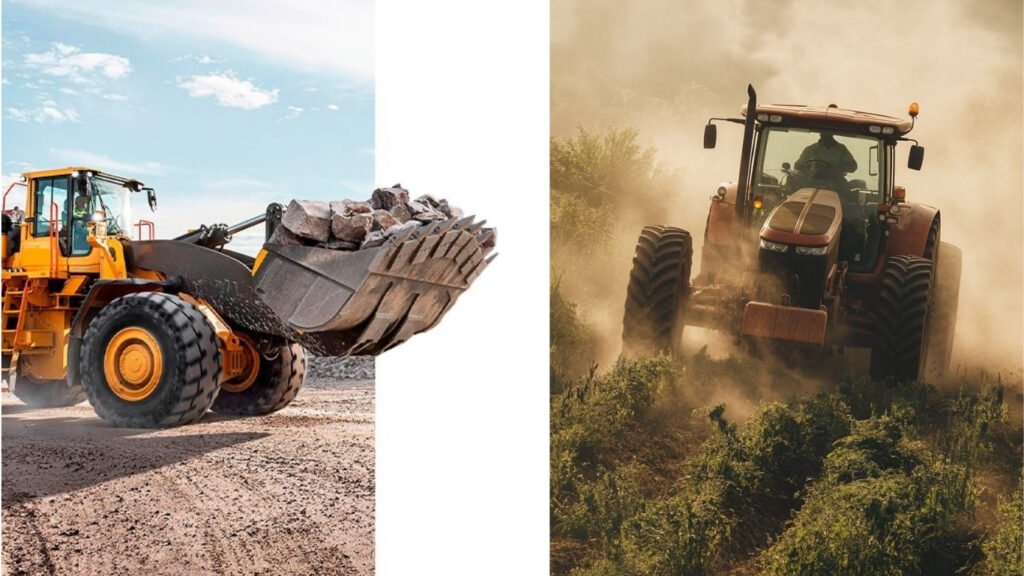
Excavators, mobile cranes, front loaders, and tower cranes all require counterweights to maintain stability under working loads. Cast iron is the preferred material because its density approximately 7.2 g/cm³ allows manufacturers to achieve the required mass within the tight dimensional constraints imposed by machine geometry. A concrete counterweight of equivalent mass would be significantly larger, creating mounting and clearance problems. Cast iron counterweights typically range from 100 kg for small forklifts to 20 tonnes for large mobile cranes, and they are manufactured to precise dimensional tolerances that allow direct bolt on installation.
Agricultural Machinery Ballast
Tractors and agricultural machinery require front and rear ballast weights to maintain traction, achieve correct axle load distribution, and comply with manufacturer specifications for safe operation. Cast iron ballast plates and suitcase weights so named for their shape and mounting system are a standard fitment on European agricultural equipment. Major tractor manufacturers specify cast iron ballast as original equipment, and aftermarket supply is a large and active market across Europe.
Elevator and Lift Counterweights
In elevator systems, counterweights serve a critical energy efficiency function they balance the weight of the car so that the motor only needs to handle the difference in load rather than the full car weight. Cast iron blocks stacked in a steel frame are the standard solution for this application. Their density allows compact counterweight assemblies that fit within the limited space of elevator shafts. The predictable dimensional consistency of cast iron castings simplifies stack assembly and weight verification.
Industrial Machinery Bases and Housings
Machine tool bases, compressor housings, pump bodies, and large industrial frames are frequently made from cast iron specifically because of its vibration damping properties. In precision manufacturing environments CNC machine tools, grinding equipment, coordinate measuring machines the base material must absorb vibration rather than transmit it. Cast iron’s graphite microstructure makes it significantly more effective at this than steel, and this property directly affects dimensional accuracy and surface finish in the finished workpiece.
Temporary Structures and Ballast
On construction sites, cast iron ballast blocks serve as base weights for temporary structures scaffolding towers, mobile cranes, formwork support systems, and barrier systems. Their high density makes them efficient for this application, and their durability means they can be used, removed, transported, and redeployed across multiple projects over many years.
Market Context
The global industrial counterweights market continues to expand, driven by growth in construction activity, agricultural mechanisation, and lifting equipment demand across Europe and export markets. Cast iron remains the dominant material for counterweight applications due to its density advantage over all common alternatives at comparable cost.
2. Six Technical Properties That Make Cast Iron Hard to Replace
Each of the applications above is served by cast iron for specific technical reasons. The following six properties explain why and why they are difficult to replicate in a single alternative material at comparable cost.
1. Density; The Fundamental Counterweight Advantage
At approximately 7.2 g/cm³, cast iron is significantly denser than concrete (2.2–2.4 g/cm³), engineered polymers, and most composite alternatives. For counterweight applications, density directly translates into compactness: the higher the density, the smaller the physical volume required to achieve a given mass. In equipment where dimensional constraints are strict elevator shafts, crane tail sections, tractor front linkages this is not a marginal advantage. It is often the deciding factor.
2. Vibration Damping; The Precision Manufacturing Advantage
Cast iron’s graphite microstructure flake graphite in grey iron, spheroidal in ductile iron gives it a vibration damping capacity approximately 10 times higher than steel. This property is critical for machine tool bases, compressor frames, and any industrial component that must maintain dimensional stability under cyclical loading. Engineers who have switched from cast iron to welded steel frames in machine tool bases and then switched back report measurable differences in surface finish and dimensional repeatability. The damping effect cannot be replicated by geometry or wall thickness alone.
3. Compressive Strength; The Structural Advantage
Grey cast iron has excellent compressive strength typically 600–700 MPa which makes it well suited to components that primarily experience compressive loading: machine bases, column supports, press frames, and bearing housings. It is weaker in tension, which is why structural applications requiring high tensile strength use ductile iron or steel instead. Understanding this distinction is key to specifying cast iron correctly.
4. Machinability; The Manufacturing Cost Advantage
Cast iron machines exceptionally well. It produces short, brittle chips rather than the long, stringy chips produced by steel, which reduces tool wear, allows higher cutting speeds, and simplifies chip management. The self-lubricating properties of graphite in the matrix further reduce tool wear. For components that require extensive machining after casting pump bodies, valve housings, hydraulic manifolds this translates directly into lower manufacturing cost per part.
5. Near Net Shape Casting; The Waste Reduction Advantage
Cast iron can be poured into complex molds to produce near net-shape components forms that require minimal post casting machining to reach final dimensions. This reduces material waste, shortens production cycles, and lowers the cost of complex geometries compared to machined from billet alternatives. For components like engine blocks, pump housings, and large frames, this advantage becomes economically significant at scale.
6. Predictable End of Life Behavior; The Maintenance Advantage
Unlike some materials that fail suddenly under fatigue loading, grey cast iron degrades gradually and visibly surface corrosion, wear patterns, and dimensional drift provide advance warning of component end of life. This predictability supports scheduled maintenance programmes rather than reactive replacement, which is operationally and commercially valuable in capital equipment with high downtime costs.
3. Cast Iron vs Alternatives: An Honest Industrial Comparison
No material comparison is complete without acknowledging where cast iron loses as well as where it wins. The table below covers the main competing materials for the industrial applications described in Section 1.
Comparison of Cast Iron, Structural Steel, Concrete, Ductile Iron,
and Aluminium Alloy
Criterion
Cast Iron
Structural Steel
Concrete
Ductile Iron
Aluminium Alloy
Density (g/cm³)
~7.2
~7.8
~2.3
~7.1
~2.7
Compressive Strength
Excellent
Good
Fair
Excellent
Good
Tensile Strength
Fair
Excellent
Poor
Excellent
Good
Vibration Damping
Excellent
Poor
Good
Good
Fair
Machinability
Excellent
Good
N/A
Good
Excellent
Near-Net-Shape Casting
Excellent
Poor
Good
Excellent
Good
Corrosion Resistance
Fair (coated)
Fair (coated)
Poor
Fair (coated)
Good
Lifecycle Cost
Low
Medium
Low–Medium
Low–Medium
Medium–High
Weight per Volume
High (✓)
High
Low (✗)
High (✓)
Low (✗)
Impact Resistance
Fair
Excellent
Poor
Excellent
Good
| Criterion | Cast Iron | Structural Steel | Concrete | Ductile Iron | Aluminium Alloy |
|---|---|---|---|---|---|
| Density (g/cm³) | ~7.2 | ~7.8 | ~2.3 | ~7.1 | ~2.7 |
| Compressive Strength | Excellent | Good | Fair | Excellent | Good |
| Tensile Strength | Fair | Excellent | Poor | Excellent | Good |
| Vibration Damping | Excellent | Poor | Good | Good | Fair |
| Machinability | Excellent | Good | N/A | Good | Excellent |
| Near-Net-Shape Casting | Excellent | Poor | Good | Excellent | Good |
| Corrosion Resistance | Fair (coated) | Fair (coated) | Poor | Fair (coated) | Good |
| Lifecycle Cost | Low | Medium | Low–Medium | Low–Medium | Medium–High |
| Weight per Volume | High (✓) | High | Low (✗) | High (✓) | Low (✗) |
| Impact Resistance | Fair | Excellent | Poor | Excellent | Good |
```
For counterweight and ballast applications, the weight per volume column is decisive: concrete and aluminum both fail this requirement at comparable cost. For machine bases and frames, vibration damping is the deciding criterion, which eliminates structural steel. Ductile iron competes most directly with grey cast iron it is stronger in tension and more impact resistant, but it costs more to produce. For standard duty counterweights and machinery bases, grey cast iron remains the cost optimal choice.
4. The European Supply Chain Perspective
Europe has a long and active cast iron foundry industry. Germany, Italy, France, and Central European countries including Poland, Czech Republic, and Hungary host major iron casting operations that supply the automotive, construction, agricultural, and industrial machinery sectors.
Why European Source Matters
For B2B buyers sourcing cast iron components for industrial applications in Europe, origin matters for several reasons beyond simple price comparison:
- CE marking and compliance: Components specified in European construction and lifting equipment must comply with European machinery and safety directives. European sourced castings are manufactured within the regulatory framework those directives require.
- Quality consistency: European foundries typically operate under ISO 9001 or equivalent quality management systems, with documented process controls and material traceability that are increasingly required in construction and agricultural equipment supply chains.
- Supply chain resilience: Post 2020 supply chain disruptions demonstrated the risk of long, complex sourcing routes. European sourced cast iron offers shorter lead times, lower logistics cost, and reduced exposure to geopolitical and freight disruption.
- Technical collaboration: European foundries are generally able to support custom specification development, tooling investment, and engineering collaboration in ways that distant commodity suppliers cannot.
The Role of Supply Chain Partners
Most end users of industrial cast iron components OEM machinery manufacturers, construction contractors, agricultural equipment dealers do not source directly from foundries. They work through specialist supply chain partners who consolidate sourcing across multiple certified production facilities, manage quality validation, handle logistics, and take commercial responsibility for the supply relationship.
This model exists because iron casting requires foundry specific tooling (molds and patterns) and technical expertise that most buyers do not maintain internally. A supply chain partner bridges that gap bringing technical specification knowledge and manufacturing access to buyers whose core competency is in their own product or project, not in casting production
5. Lifecycle Cost: Why the Initial Price Is Rarely the Full Story
Cast iron has a higher initial unit cost than concrete for equivalent-mass counterweight applications, and a higher machining cost than some alternative materials for certain component geometries. Buyers who evaluate material choice on initial price alone sometimes move away from cast iron and sometimes move back.
A complete lifecycle cost analysis for industrial cast iron components needs to include the following factors:
| Cost Factor | Cast Iron | Concrete (Counterweights) | Steel (Machinery Bases) |
|---|---|---|---|
| Initial Material Cost | Medium | Lower | Higher |
| Machining Cost | Low–Medium | Not Applicable | Higher |
| Tooling (First Run) | Required | Lower | Required |
| Coating / Protection | Standard | Higher | Standard |
| Service Life | 25–50+ years | 15–25 years | 25–40 years |
| Replacement Frequency | Low | Higher | Low |
| End-of-Life Value | Scrap Value | Disposal Cost | Scrap Value |
| Total Lifecycle Cost | Low | Medium | Medium |
The service life differential is particularly significant for counterweight and ballast applications where components are deployed on capital equipment with a 20-to-30-year operational life. A cast iron counterweight specified for an excavator in 2026 should still be performing when that machine is retired meaning zero replacement cost over the machine’s life. Concrete counterweights in comparable applications may require inspection and replacement within that period.
Procurement Note
When evaluating cast iron versus alternatives for industrial applications, ask suppliers for a total cost of ownership figure that includes installation, protection, expected service life, and end of life treatment not just the unit price. In most industrial applications, this analysis favours cast iron even when the initial unit cost is higher than alternatives.
6. What Procurement Managers Need to Know
For procurement managers sourcing cast iron components for industrial supply chains, the following points represent the practical essentials.
Specify the Grade, Not Just ‘Cast Iron’
‘Cast iron’ covers a family of materials with significantly different properties. Grey cast iron (EN-GJL to EN 1561), ductile iron (EN-GJS to EN 1563), and malleable iron have different strength, ductility, and machinability profiles. Specifying the correct grade for the application is essential a component specified as EN-GJL-250 and supplied as EN-GJL-150 will underperform. Require material certification from your supplier.
Understand Tooling Costs and Amortisation
Cast iron components require foundry tooling patterns and core boxes that must be designed, manufactured, and validated before production begins. For custom components, this tooling cost is a one-time investment amortised over the production run. It means that cast iron is expensive at low volumes and increasingly cost competitive as volumes grow. Understand the break-even volume for your application before committing to a custom casting versus a standard or near standard component.
Require Traceability Documentation
For components used in construction equipment, lifting machinery, or agricultural systems that fall under European machinery directives, traceability documentation material certificates, dimensional inspection records, foundry process records are not optional. Require it contractually from your supplier and verify that it is available before accepting delivery.
Plan Lead Times Realistically
Custom cast iron components have longer lead times than machined or fabricated alternatives typically 8 to 16 weeks from tooling approval to first delivery for new castings, depending on complexity, foundry loading, and heat treatment requirements. Build this into project planning. Standard and catalogue components have shorter lead times, but custom geometry typically requires the full cycle.
7. Frequently Asked Questions
Why do European manufacturers still use cast iron when advanced alloys exist?
For the specific applications where cast iron is primarily used counterweights, machinery bases, agricultural ballast advanced alloys do not offer a practical advantage that justifies their higher cost. A titanium counterweight would achieve the same mass in a smaller volume, but the cost differential is prohibitive for a commercial application. Cast iron occupies a well defined cost-performance space that alternatives fill either incompletely or at greater cost.
Is cast iron sustainable from an environmental standpoint?
Cast iron is fully recyclable it can be melted down and recast without significant loss of structural performance. Iron foundries routinely use recycled scrap as a primary feedstock. The near net shape casting process also reduces material waste compared to machined from billet approaches. These properties mean that cast iron components at end of life typically have positive scrap value, unlike composite or polymer alternatives that generate disposal cost.
What is the difference between grey cast iron and ductile iron for industrial applications?
Grey cast iron has flake graphite in its matrix, which gives it excellent vibration damping and machinability but relatively low tensile strength and limited impact resistance. Ductile iron (also called nodular or spheroidal graphite iron) has a different graphite structure that makes it significantly stronger in tension and much more impact resistant, at the cost of somewhat lower vibration damping and higher production cost. For static counterweights and machine bases, grey cast iron is typically preferred. For components subject to dynamic loading and impact, ductile iron is often specified instead.
How does cast iron compare to fabricated steel structures for industrial frames?
Fabricated steel structures welded plate and section assemblies can achieve similar or higher load ratings than cast iron at lower material cost. Their disadvantage is poor vibration damping, which is critical for precision machinery bases, and higher fabrication cost for complex geometries that would be straightforwardly cast. For simple structural frames, steel is often preferred. For complex geometries requiring vibration control, cast iron castings typically win on lifecycle cost.
How does Castinex support industrial cast iron procurement?
Castinex coordinates cast iron supply for B2B clients across Europe through structured manufacturing partnerships with certified European producers. Our team supports technical specification review, sourcing from appropriate foundry partners, quality documentation, and logistics providing a single point of contact for industrial cast iron components across applications including counterweights, machinery components, agricultural ballast, and infrastructure castings. Contact us at info@castinex.eu to discuss project requirements.
Conclusion
Cast iron’s continued presence in European industrial supply chains is a straightforward engineering and commercial outcome. For the applications where it is specified counterweights, agricultural ballast, machinery bases, elevator systems, and infrastructure castings it delivers a combination of density, vibration damping, machinability, and lifecycle cost that no single alternative material has yet matched at commercial scale.
That is why European manufacturers still choose it. Not because alternatives do not exist. Because the alternatives, taken individually and evaluated honestly across a full lifecycle, have not yet displaced it from its core applications.
Looking for industrial cast iron supply?
Castinex supplies cast iron components for industrial, construction, agricultural, and infrastructure applications to B2B clients across Europe sourced from certified European manufacturing partners with validated quality processes. Contact us: info@castinex.eu | castinex.eu | +36 70 638 0578 CASTINEX by Duna Commerce & Fabrication Kft. | 1134 Budapest, Váci út 47B
About Castinex
Castinex is a European-managed cast iron specialist, coordinating production for B2B clients across Europe through structured manufacturing partnerships and engineering-based planning. We support OEM and private label projects with technical validation, controlled processes, and reliable supply execution all aligned with European market expectations. Our product range spans cast iron cookware, infrastructure castings, drainage systems, and industrial components including counterweights, agricultural ballast, and machinery bases.
Contact: info@castinex.eu | castinex.eu | +36 70 638 0578